
Understanding Fascia, Myofascial Pain, and How Chiropractic Care and Massage Therapy Can Help
When something feels tight, stiff, or sore, we tend to blame the muscle. A tight neck must mean tight neck muscles. Persistent tension through the hips must mean the hip muscles need to be stretched. That stubborn spot in the lower back must be a muscle that simply refuses to loosen up. Sometimes, the muscle is certainly part of the problem. But muscles do not function independently. They are surrounded, supported, and connected by layers of connective tissue called fascia, and this tissue plays an important role in how comfortably and efficiently the body moves.
Fascia has received significantly more attention in the health and wellness world in recent years, although not everything said about it is necessarily accurate. You may have heard about “releasing fascia,” “breaking up fascia,” or even storing stress and toxins in fascial tissue. The reality is more nuanced, and much more interesting. Understanding what fascia actually is can provide a better picture of why stiffness, restricted movement, and musculoskeletal pain are not always as simple as finding one tight muscle and stretching it.

What Is Fascia?
Fascia is connective tissue found throughout the body. Depending on the anatomical definition being used, fascia can refer to fibrous sheets and membranes that surround, separate, support, and connect muscles and other structures, or more broadly to a body wide system of connective tissues. Researchers continue to refine exactly how the fascial system should be defined, but its importance in providing structural support and allowing tissues to move in relation to one another is well established.
One way to picture fascia is to think beyond individual muscles on an anatomy chart. Although we often name and discuss muscles separately, the body does not move as a collection of completely independent parts. Muscles, connective tissues, joints, nerves, and other structures continuously interact to produce movement.
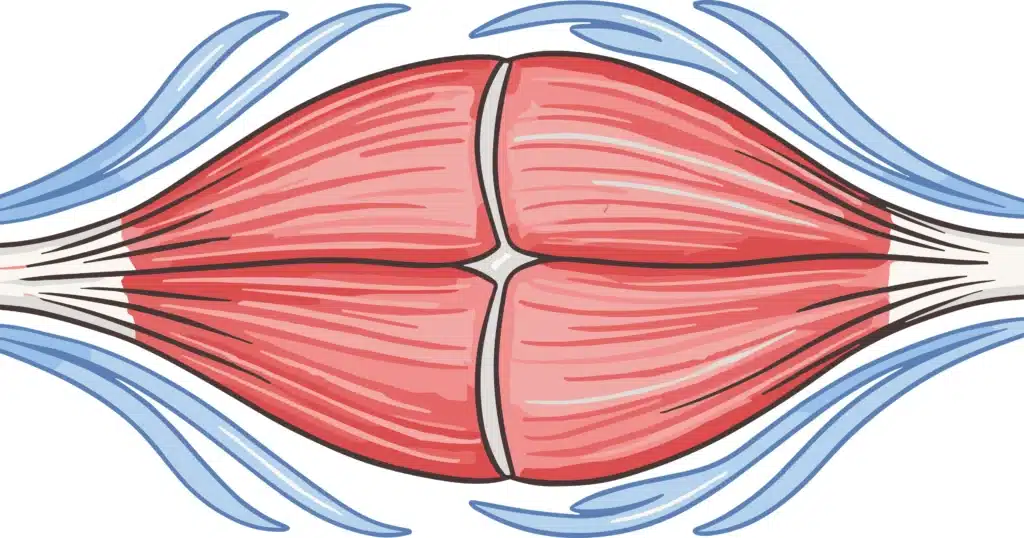
Fascial tissue helps create that interconnected environment. It surrounds and separates structures, helps transmit mechanical forces, contributes to stability, and provides surfaces that allow adjacent tissues to glide as we bend, reach, walk, lift, and rotate. Fascia is also innervated, meaning it contains sensory nerve endings and can contribute to proprioception: the body’s awareness of its position and movement. That is why fascia is more than simply “wrapping” around a muscle. It is part of the mechanical and sensory system that helps the body move.
What Happens When Fascia Is Not Moving Well?
Fascia is living tissue that responds to the demands placed on the body. Injury, repetitive loading, surgery, prolonged inactivity, changes in movement patterns, and other physical stresses can influence the way connective tissues behave.
When movement between tissue layers becomes less efficient or an area becomes sensitive, the experience is not always a sharp, easily identifiable pain. Some people notice a persistent feeling of tightness or pulling. Others may experience tenderness, stiffness after sitting for extended periods, reduced range of motion, or discomfort during particular movements.
This is one reason repeatedly stretching the muscle that “feels tight” does not always provide lasting relief. The sensation may involve several structures within the area rather than one isolated muscle.
The lower back is a good example. The thoracolumbar fascia is a substantial connective tissue structure associated with the muscles of the back and trunk. Its anatomy, innervation, and relationship with surrounding muscular structures have made it an area of interest in research examining lower back and pelvic pain.
Rather than assuming every ache is a “fascia problem,” the more useful question is why the area feels restricted or uncomfortable in the first place?
What Can Fascial and Myofascial Problems Feel Like?
There is no single symptom that automatically means fascia is responsible for someone’s discomfort. Musculoskeletal symptoms can have many causes, which is why proper assessment matters. However, fascial and myofascial involvement may be considered when someone experiences persistent stiffness, localized tenderness, restricted range of motion, discomfort associated with certain movements, or a sensation of tension or pulling that does not seem limited to one specific muscle.
People sometimes describe an area as feeling like it needs to be stretched constantly, yet stretching provides only temporary relief. Others notice that discomfort returns after sitting at a desk, driving, exercising, or repeating the same movements throughout the workday. These symptoms do not necessarily mean the fascia itself needs to be “released.” Instead, they may be clues that a practitioner should look more closely at how the muscles, joints, connective tissues, and movement patterns in that region are working together.
Why the Painful Spot Is Not Always the Whole Story
If your shoulder hurts, it is natural to focus entirely on the shoulder. If your lower back feels tight, you probably stretch your lower back. But musculoskeletal assessment often requires looking beyond the exact location of the symptom. Movement is shared across multiple joints and tissues. If one area is not moving efficiently, another may begin doing more work to compensate.
For example; reduced mobility through the thoracic spine can change how someone moves through the shoulders and neck. Changes in hip movement can alter how forces are managed through the pelvis and lower back. A repetitive working posture can create different demands through the chest, shoulders, neck, and upper back.
Fascia is one component of these relationships, but it should not be considered in isolation. Understanding the bigger movement pattern can help explain why treating only the area that hurts may not always address the factors contributing to the problem.
How Registered Massage Therapy Can Help
Registered Massage Therapists work with muscles and other soft tissues to address pain, tension, mobility, and function. Depending on the assessment and treatment goals, massage therapy may include techniques that influence the muscles and surrounding connective tissues rather than concentrating solely on a single painful spot. Manual pressure and movement can temporarily influence tissue mobility, sensitivity, and range of motion. Research into specific fascial manipulation techniques has shown potential improvements in pain and mobility for some musculoskeletal conditions, although the evidence continues to develop and researchers have noted limitations in the quality and consistency of existing studies.
This is an important distinction. Massage therapy is not literally “breaking apart” fascia. Instead, hands-on treatment may help influence how an area feels and moves while giving the practitioner an opportunity to address surrounding tissues that may be contributing to the patient’s symptoms.
At Port Perry Wellness Centre, registered massage therapy can be incorporated into a broader treatment approach based on what the individual is experiencing, how they move, and what they need to return to their normal activities.
Where Chiropractic Care Fits In
Fascia does not operate separately from the joints and muscles it surrounds. How a joint moves can affect the demands placed on nearby soft tissues, while muscular tension and movement patterns can influence how comfortably a joint moves.
This is where chiropractic care can provide another perspective.
A chiropractor can assess joint mobility, range of motion, posture, and movement patterns to determine whether certain areas are moving differently or compensating for another region. Treatment may include chiropractic adjustments or mobilizations alongside soft tissue techniques, movement recommendations, and exercises depending on the patient’s needs.
The goal is not to “adjust the fascia.” Instead, chiropractic care can address the mechanical environment in which those tissues are functioning. Improving movement through a restricted joint, for example, may change how surrounding muscles and connective tissues are being loaded during everyday activity.
This is also why combining different approaches to musculoskeletal care can sometimes be beneficial. Massage therapy may focus more extensively on soft tissues, while chiropractic care can address joint mechanics and movement. The treatment plan should ultimately be determined by what is found during assessment rather than by assuming one technique is appropriate for every patient.
What About Cupping and Other Adjunctive Therapies?
Cupping and other adjunctive techniques may also be incorporated into treatment when clinically appropriate. Cupping uses negative pressure to lift the skin and superficial tissues rather than applying downward pressure in the way many massage techniques do. For some patients, practitioners may use it as part of treatment to address soft tissue discomfort, mobility, or muscular tension.
The circular marks commonly associated with cupping are caused by changes in superficial blood vessels beneath the skin. They are not evidence that toxins have been “pulled” from the body, despite a common misconception online. Adjunctive therapies should be viewed as exactly that: adjuncts to care. They are tools a practitioner may incorporate when appropriate, rather than standalone solutions for every type of pain or restriction.
Why Movement Matters Just as Much as Treatment
Hands on care can be valuable, but what happens between appointments matters too.
Connective tissues respond to mechanical loading and movement. Regular activity exposes the body to different ranges of motion and forces, while spending long periods in the same position repeatedly limits the variety of movement the tissues experience. That does not mean there is one “perfect posture” everyone needs to maintain throughout the day. In fact, changing positions regularly is often more realistic and useful than trying to hold one supposedly ideal posture for eight hours.
Walking, strength training, mobility exercises, taking movement breaks during the workday, gradually returning to activity after an injury, and following exercises recommended by your healthcare provider can all be part of supporting long-term musculoskeletal health. Manual therapy can help create an opportunity for more comfortable movement, but movement itself remains an important part of maintaining function.
Fascia Is Part of the Picture, Not the Entire Picture
The growing conversation around fascia has helped bring attention to an important part of human anatomy, but it has also created some misconceptions. Not every pain is caused by “tight fascia,” and not every restriction needs to be “released.” Pain and movement are complex. Muscles, joints, connective tissues, the nervous system, previous injuries, activity levels, repetitive demands, recovery, and many other factors can influence how the body feels.
That is why individualized assessment matters! At Port Perry Wellness Centre, our chiropractic care, registered massage therapy, and adjunctive treatment options are designed around the person rather than a single symptom. If you are dealing with ongoing stiffness, restricted mobility, muscle tension, or musculoskeletal discomfort, understanding what is contributing to the problem is an important first step toward determining the right approach to care.
Experiencing persistent tightness or discomfort that stretching alone is not resolving? Contact Port Perry Wellness Centre to book an appointment with one of our chiropractors or Registered Massage Therapists and learn more about the treatment options that may be appropriate for you.
